LiDAR research shifts perspective from drivers to pedestrian safety
Published: Sep 14, 2026 3:00 PM
By Dustin Duncan
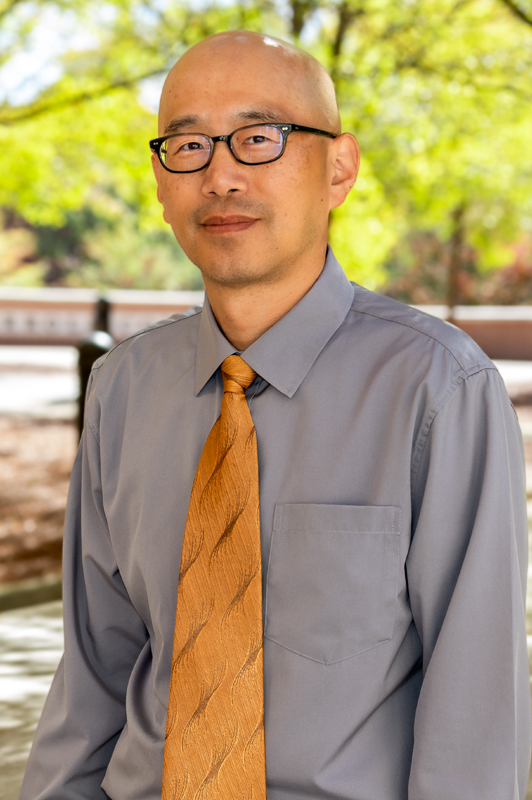
 Huaguo Zhou, the Elton Z. and Lois G. Huff Professor of Transportation of civil and environmental engineering, is developing a LiDAR-based tool to help ALDOT evaluate pedestrian sight distance at unsignalized intersections and midblock crosswalks.
Huaguo Zhou is expanding his research on a LiDAR-based tool that evaluates what drivers can see at intersections, this time turning his attention to the view from the crosswalk.
Zhou, the Elton Z. and Lois G. Huff Professor of Transportation in the Department of Civil and Environmental Engineering, has a new Alabama Department of Transportation (ALDOT) project focused on developing a tool to measure pedestrian crossing sight distance at unsignalized intersections and midblock crosswalks.
The goal is to help transportation agencies identify locations where trees, parked vehicles, roadway geometry or other obstructions may prevent pedestrians from seeing approaching traffic with enough time to cross safely.
“We are trying to solve a puzzle: why do so many pedestrians get hit at crosswalks, especially ones without a traffic signal?” said Zhou, who also leads a $350,000 national study on pedestrian sight distance. “The answer is often that they just can’t see the oncoming car in time.”
Zhou described pedestrian crossing sight distance as the amount of roadway a person needs to be able to see clearly before stepping off the curb. A pedestrian must not only see an approaching vehicle but also see it early enough to determine whether there is sufficient time to cross the full width of the road.
“If the road is 40 feet wide and you walk at 3.5 feet per second, you need about 11 seconds,” Zhou said. “So, you need to be able to see far enough down the road to spot any car that is less than 11 seconds away. If something is blocking that view, you are crossing blind.”
The project builds directly on prior ALDOT research led by Zhou, which produced a GIS- and LiDAR-based tool for evaluating intersection sight distance at two-way stop-controlled intersections.
That project focused on drivers.
At stop-controlled intersections, drivers need a clear view of approaching traffic before entering or crossing the roadway. Zhou’s team used LiDAR — which creates detailed 3D representations of the roadway environment — to measure drivers’ sight lines remotely and identify objects that could block them.
The method was validated against field measurements and applied to more than 230 intersections across Alabama.
“We proved you can do this kind of analysis remotely and on a massive scale,” Zhou said. “Once we had this proven ‘engine’ that could measure visibility for a driver, it was a logical next step to ask: ‘Can we use the same engine to measure visibility for a pedestrian?’”
The new project will use much of the same LiDAR and GIS technology developed through the earlier ALDOT work, but will apply it from the pedestrian’s point of view.
“The first project was entirely driver-centric: it looked at vehicle-to-vehicle interactions and whether a driver could see oncoming traffic,” Zhou said. “This new project is entirely pedestrian-centric: it looks at pedestrian-to-vehicle interactions and whether a person at the curb can see traffic well enough to cross safely.”
The pedestrian-focused tool will account for differences in eye height among adults, children and wheelchair users, as well as how long a pedestrian needs to cross the full width of a roadway. It will also consider lower targets, such as the headlights of approaching vehicles at night.
Zhou said the finished tool could allow ALDOT to screen large numbers of pedestrian crossings, identify locations with limited visibility and determine what is blocking the view. Agencies could then prioritize improvements ranging from trimming vegetation or changing parking restrictions to more substantial changes at a crossing.
“Our goal is to equip them to be proactive,” Zhou said. “We want them to be able to identify and fix dangerous crosswalks before a crash happens.”
Media Contact: , dzd0065@auburn.edu, 334-844-2326