‘Look at all the cool things plants can do’: Assistant professor authors children’s book
Published: Sep 8, 2026 7:40 AM
By Joe McAdory
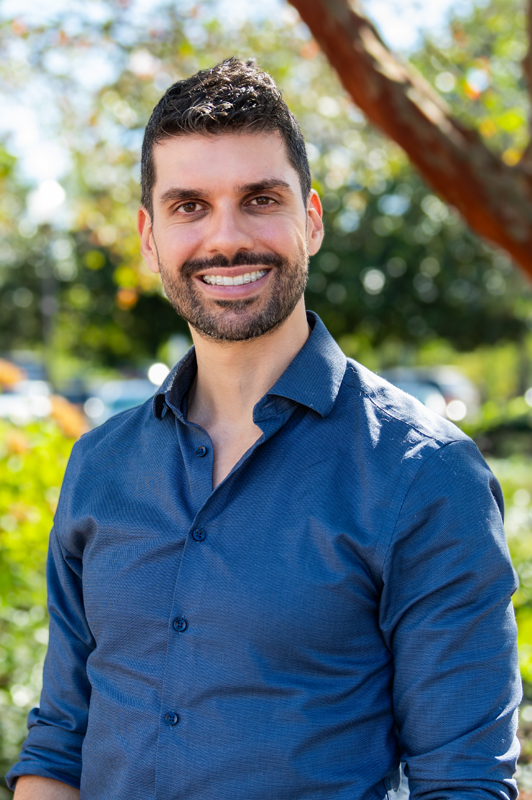
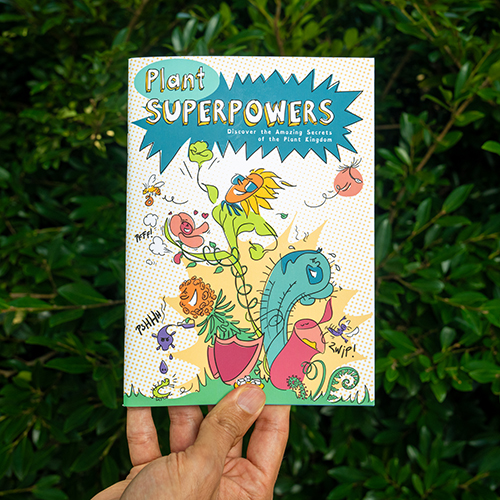
 Jean-Francois Louf, assistant professor in the Department of Chemical Engineering, authored a colorful, 44-page children's book, “Plant Superpowers: Discover the Amazing Secrets of the Plant Kingdom,” which combines science lessons with interactive challenges, experiments, puzzles and illustrations.
Plants don’t run, they don’t bark, and they certainly don’t fly.
“Most people think plants don't do very much, but when you really look closely, plants are constantly sensing their environment, moving, communicating, defending themselves, and adapting to changing conditions,” said Jean-Francois Louf, assistant professor in the Department of Chemical Engineering. “Once you realize that, you start seeing every tree and flower differently.”
Louf explores this hidden world in a colorful, 44-page children's book, “Plant Superpowers: Discover the Amazing Secrets of the Plant Kingdom,” which combines science lessons with interactive challenges, experiments, puzzles, and illustrations by graphic artist Marie-Lys Errard.
“Children will discover how plants reproduce, survive extreme heat, drought, and freezing temperatures, and grow from a tiny seed into a mature plant,” said Louf, who directs the university’s Nature-Inspired Fluids & Elasticity Lab. “They'll learn how plants make sugar from sunlight, communicate with insects, defend themselves against predators, and respond to the world around them.
“When children think about biology, they often think about animals. Animals move, play, and behave in ways that immediately capture our attention. Plants seem quiet by comparison, but they're actually doing so many things. I wanted to tell children, ‘Hey, look at all the cool things plants can do,’ and make them curious enough to start looking at plants differently.”
Written for children ages 6–12, the paperback uses a comic-book format to make scientific concepts approachable and engaging. Each of its 11 chapters focuses on a different plant “superpower” and begins with questions designed to spark curiosity.
“At the end of each chapter, kids can try a DIY experiment at home and see some of these phenomena for themselves,” said Louf, who earned a National Science Foundation CAREER Award in 2025 for his project, “Mechanisms of Acoustic Signal Processing for Increased Nectar Sugar Concentration in Flowers,” which examines how plants translate mechanical vibrations into biochemical changes.
Key points within the book include:
- Plants exchange information through airborne chemicals, root-secreted compounds, and underground fungal networks.
- Plants cooperate with animals, including ants, for protection.
- Plants produce chemical defenses that can discourage or repel predators.
- Plants use sunlight, water, and carbon dioxide to make sugars, converting solar energy into chemical energy.
- Plants sense touch and other environmental cues and respond by changing their growth and movement.
Growing up in Nice, France, Louf learned quickly that children love to ask questions.
“My neighbors’ children were much younger than me, maybe about five or six years old,” he said. “When kids are young, they ask so many questions. ‘Why is the sky blue?’ ‘Why is it cold?’ ‘Why does this happen?’ That’s wonderful, but if we don’t nurture that curiosity and help them find answers, they'll eventually stop asking questions, and that would be a shame.
“The idea behind this book is to encourage that curiosity, to explore the world and see plants from a different point of view. When you look at a tree, it seems like it's doing nothing. But inside, it's incredibly active. I want children to start noticing that hidden world and realize just how remarkable plants are.”
Louf has already visited elementary school classrooms to present the book with students and donated copies to schools and libraries as part of his STEM outreach efforts. Digital editions will also be available through Google Play Books.
Media Contact: , jem0040@auburn.edu, 334.844.3447