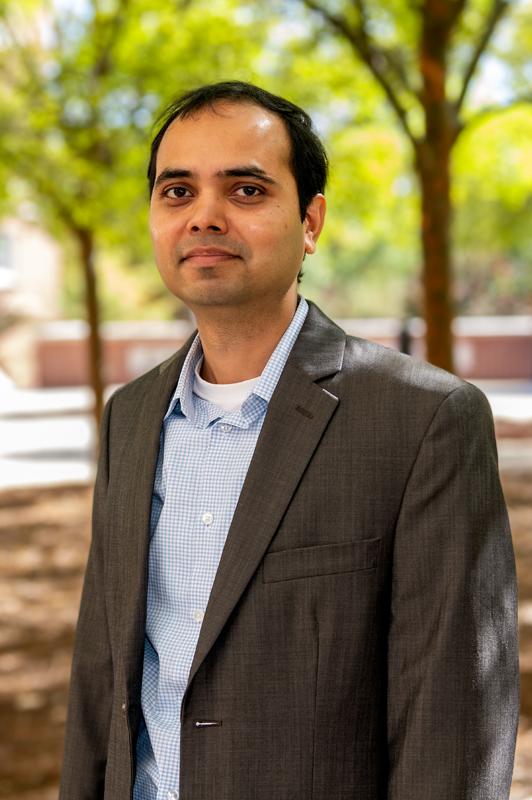
Aerospace assistant professor receives NSF fellowship to advance multiphysics flow simulations
Published: Jun 17, 2026 1:25 PM
By Dustin Duncan
 Nek Sharan, aerospace engineering assistant professor, works in his office. His NSF fellowship will support the development of computational tools for simulating complex, high-speed flows in aerospace systems.
Nek Sharan, assistant professor of aerospace engineering, has received a National Science Foundation (NSF) fellowship to develop computational tools for predicting and reducing shock-induced vibrations in high-speed aerospace systems.
Through the NSF EPSCoR Research Infrastructure Improvement Program, Sharan will collaborate with researchers at the Department of Energy national laboratories to improve simulations and control of complex flows in supersonic and hypersonic environments. The project focuses on shock-induced vibration, a phenomenon that can affect the structural integrity of aircraft, spacecraft, rocket nozzles, engine intakes and other aerospace systems operating at high speeds.
The fellowship builds on Sharan’s previous NSF-supported work developing computational tools for flow-induced vibration and high-speed compressible flows. This latest project expands that research to include shock-induced vibration, artificial intelligence (AI) and exascale supercomputing.
“When an aircraft or spacecraft reaches supersonic or hypersonic speeds, they generate shock waves, which are extreme, high-amplitude pressure waves,” Sharan said. “They can strongly influence the aerodynamics and structural integrity of these vehicles.”
Shock-induced vibration can occur when shock waves generated at high speeds push against aircraft, spacecraft, or engine components. If engineers cannot accurately predict those forces, they may not know how to design critical structures — such as engine intakes, compressor blades, rocket nozzles, or spacecraft heat shields — to withstand vibration, fatigue, and potential failure.
Sharan said the project could help engineers make more informed decisions before expensive physical testing in a wind tunnel and flight experiments.
“If they don’t understand the forces these structures experience, they cannot choose a robust design, size/thickness or material for them,” he said. “This study will help accurately estimate the forces produced on these surfaces when shock waves are generated at high speeds.”
Computational simulations allow engineers to evaluate high-speed vehicle designs more safely and less expensively than physical testing, but they still require significant time and computing power. Sharan said simulating a single vehicle or engine component design can take several days on thousands of processors, making it impractical to test every possible design change.
The project will use AI to speed up that process. By learning which flow features matter most, AI could help researchers evaluate designs in minutes rather than days as they refine shapes to reduce structural vibrations.
“Knowing the behavior for certain geometries, we are trying to work out the best geometry,” Sharan said. “It’s an optimization problem in a high-dimensional parameter space.”
National Laboratories will play a central role in helping Sharan adapt his computational tools for some of the world’s most advanced supercomputers. By working with national laboratory researchers who specialize in scientific computing, Sharan said simulations that currently take several days could be reduced to a few hours.
Sharan said the collaboration also gives him access to researchers with experience studying shock-dominated flows, as well as experimental data that can help validate the simulations.
“Computational tools are not trustworthy until we validate them with reality and data on extreme conditions of interest here, such as those encountered by re-entry vehicles or post-explosion in a combat zone, is rare,” he said.
If successful, the project will give Sharan’s research group a fast, robust computational tool for simulating complex flow problems across a wide range of speeds. Though the immediate focus is shock-induced vibration, the same framework could later support simulations of turbulent combustion in rocket engines, gas turbine engines, and other propulsion systems.
“We will have a multiphysics computational solver that could simulate complex flows, such as those involving fluid-structure interactions and combustion, as efficiently as possible with existing computational resources,” Sharan said.
Media Contact: , dzd0065@auburn.edu, 334-844-2326