Engineering well represented at Auburn Research Symposium
Published: Apr 2, 2026 8:40 AM
By Joe McAdory
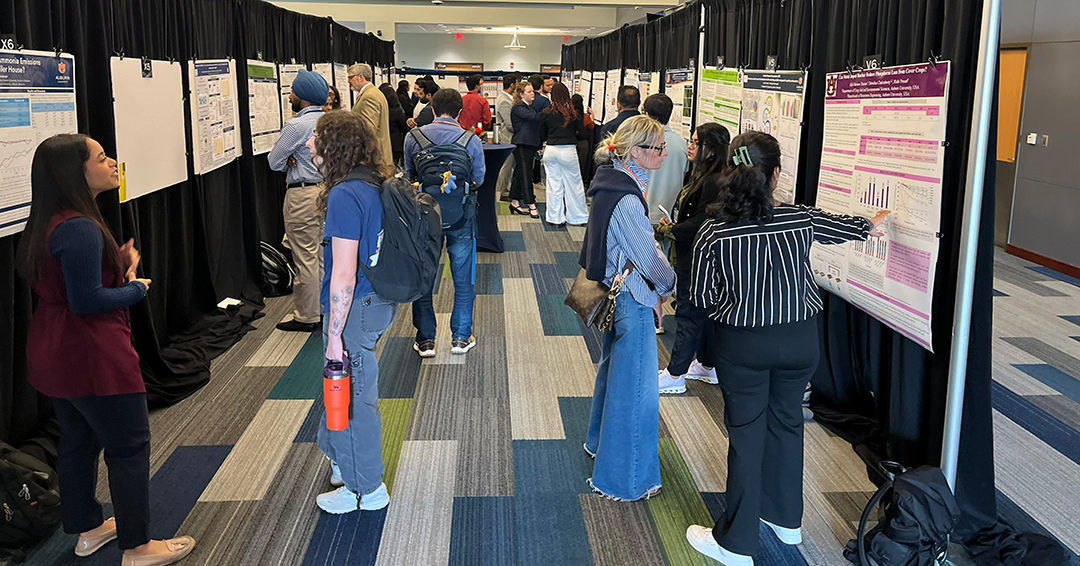 The annual research symposium drew nearly 500 students and postdoctoral researchers, who presented their work before faculty and peers.
John Lieb, a senior in computer science and software engineering (CSSE), and mechanical engineering graduate student Ryan Pollard earned university-wide awards for oral research presentations at the Auburn University Research Symposium held Thursday, March 26 at the Melton Student Center.
The annual research symposium drew nearly 500 students and postdoctoral researchers, who presented their work before faculty and peers. The event awards top oral and poster presentations, along with two honorees from each participating college. Categories span science, technology, engineering and mathematics, human sciences, social sciences, creative arts, nursing and the humanities.
"This event provided our students with essential professional development opportunities and underscored the research culture at Auburn.” said Lorenzo Cremaschi, director of undergraduate research at Auburn University and professor in the Department of Mechanical Engineering. “Through oral and poster presentations, our students took the stage and were placed under the spotlight to showcase their work. Their accomplishments underscore the university's pivotal role in shaping the future of research and creative scholarship across disciplines.”
Lieb, mentored by Sathya Aakur, associate professor of CSSE, won first place among undergraduates in the science, technology, engineering and mathematics category for his oral presentation, “Learning predictive signals from satellite imagery for commodity futures markets.”
In this research, Lieb explained that commodity markets move on real‑world conditions, but traders rarely have a clear view of what’s happening on the ground. This study tests whether satellite photos can fill that gap. By turning monthly images of Iowa corn fields into patterns a computer can track and comparing them with the next month’s corn‑futures prices, the researchers found consistent links, strongest when markets were volatile. The most predictive images came from the same regions, suggesting that certain landscape features reliably signal price shifts. Lieb said this approach could be applied to other crops and regions.
Pollard, mentored by Auburn Alumni Engineering Council Associate Professor Michael Zabala, won second place among graduate students in the science, technology, engineering and mathematics category for his oral presentation, “Mind the Gaps: Robustness of DNN Ankle Joint Angle Prediction Models to Unexpected Sensor Flatlines.”
His research examined how well lower‑limb prediction models perform when wearable sensors fail. By deliberately “flatlining” sensors in the data, he trained two‑layer long short‑term memory models — a type of neural network that learns patterns over time — to predict ankle motion under different sensor setups. Performance dropped when sensors went dead, but models exposed to these simulated failures during training held up far better. The findings show that missing or frozen sensor data can seriously weaken real‑world performance, and that building those failures into training is a simple way to make the models more resilient.
Engineering-specific awards for oral presentations were awarded to Md Roknuzzaman, a graduate student in civil and environmental engineering, for his study “Safe for Cars: Does it mean safe for pedestrians? A Case Study,” and to aerospace engineering senior Cade May for “Analysis of a Generic T-tail Transport Using a Surface-Vorticity Panel Method Flow Solver at Low Angles of Attack.”
Engineering-specific awards for poster presentations were given to Haley Duncan, a graduate student in mechanical engineering, for her study “A Biomechanical Ergonomic Assessment for Injury Prevention in Healthcare Professionals,” and the mechanical engineering senior Lauren Mohler for “A Comparative Evaluation of Kalman and IMM Filters for Vehicle State Estimation.”
Zarin Tasnim, a graduate student in biosystems engineering, was recognized for best poster presentation among graduate students within the College of Agriculture for his study “Fluorescence-based sensor for detection of sulfur-containing volatile compounds in poultry environments.”
Media Contact: , jem0040@auburn.edu, 334.844.3447