ASEL advances faster steel construction with AISC-funded drop-in connection research
Published: Jan 12, 2026 10:30 AM
By Dustin Duncan
Auburn Engineering is continuing work on a new beam connection that could make steel-frame buildings faster and safer to construct, as part of a two-year research project funded by the American Institute of Steel Construction (AISC).
The project builds on a national AISC competition that selected Auburn’s “drop-in” top flange connection concept for further development. The connection is designed to simplify how steel beams are joined during construction by allowing them to be lowered vertically into place and temporarily supported before bolting — a change that could save time on job sites, according to Matthew Yarnold, director of Auburn’s Advanced Structural Engineering Lab (ASEL) and associate professor of structural engineering in the Department of Civil and Environmental Engineering.
“The steel industry competes with the concrete industry,” Yarnold said. “Their big advantage in many cases is speed. You can put a building together faster with steel than with reinforced concrete.”
Traditional steel beam connections require workers to align beams horizontally and install multiple bolts while a crane holds the member in place. The drop-in connection shifts more fabrication work into the shop and reduces the fieldwork required at height. Angles are pre-attached to the supporting member, and the incoming beam’s bottom flange is coped so it can be lowered straight into place and remain stable even before bolts are installed.
“It’s easier to assemble in the field because you drop it in and you’ve got fewer bolts,” he said. “It’s also more stable because if it’s just seated — even without bolts — it remains secure. You could technically release the crane without the beam shifting.”
The initial phase of the project, known as the “Drop-In Top Flange Connection,” was completed in March 2025 and demonstrated that the concept was technically viable. That phase included full-scale laboratory testing and numerical modeling, as well as the development of design guidance submitted to AISC for potential inclusion in the Steel Construction Manual, the industry’s primary design reference for steel construction. The connection is currently under consideration by an AISC committee ballot.
The new phase, titled “Drop-In Top Flange Extended Connections,” will apply the same concept to beam-to-girder connections, which are common throughout the interior framing of multistory steel buildings. The project will run for two years, with work taking place at ASEL.
The team will use a combination of modeling and full-scale testing to evaluate connection behavior and develop design recommendations that address this more complex framing condition. If successful, the expanded approach could help reduce field erection time and bolting demands in typical beam-to-girder situations.
“This is where the research can have real-world impact and move from research into practice,” he said. “Practicing engineers will design using these connections, and contractors will build with them.”
Yarnold said if the work proves successful, the results could move quickly from the research phase into the code development cycle and eventually into real construction practice.
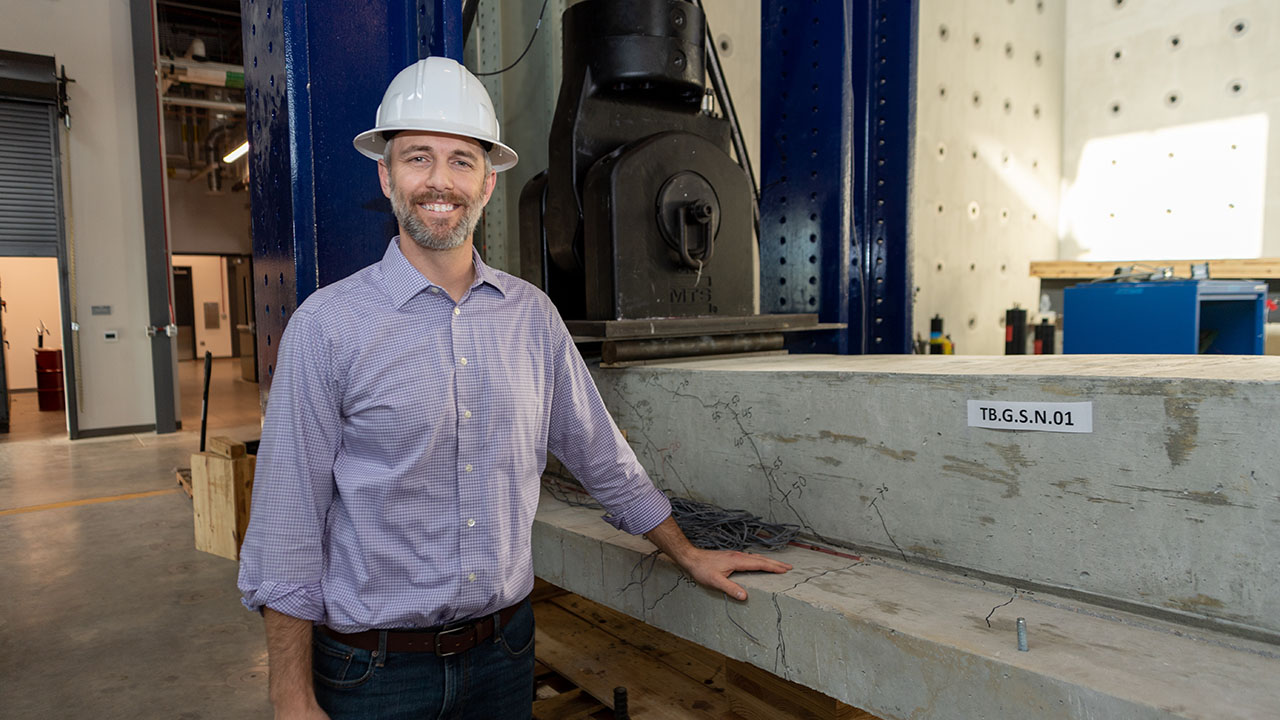
Matthew Yarnold, director of Auburn’s Advanced Structural Engineering Lab and associate professor of structural engineering.